

If you are planning an onsen trip in Japan, you may come across the term 源泉かけ流し, often written in English as gensen kake-nagashi. For many hot spring enthusiasts, this phrase is one of the most attractive things a bath can advertise. It suggests freshness, authenticity, and a closer connection to the original hot spring source.
This is one of the most desirable labels for hot spring lovers, but it can be confusing if you are not familiar with Japanese onsen terminology.
What Does Gensen Kake-Nagashi Mean?
In simple terms, gensen kake-nagashi means fresh hot spring water from the source continuously flows into the bath and is not reused. The water enters the tub, fills it, and then overflows or drains away rather than being filtered and returned.
The word 源泉, or gensen, refers either to the place where hot spring water emerges from the ground or to the hot spring water itself after it has surfaced. The phrase かけ流し, or kake-nagashi, describes the way the water is supplied: it flows into the bath continuously and is discharged after use.
This is why gensen kake-nagashi is often translated as source-fed free-flowing hot spring water.
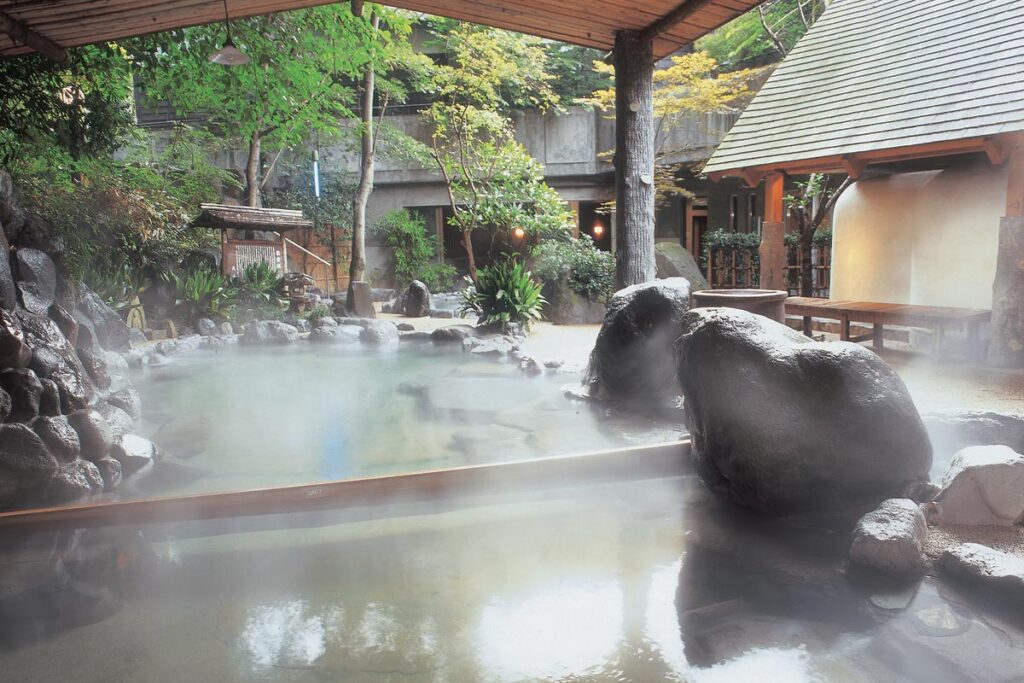
What Is a Hot Spring Source?
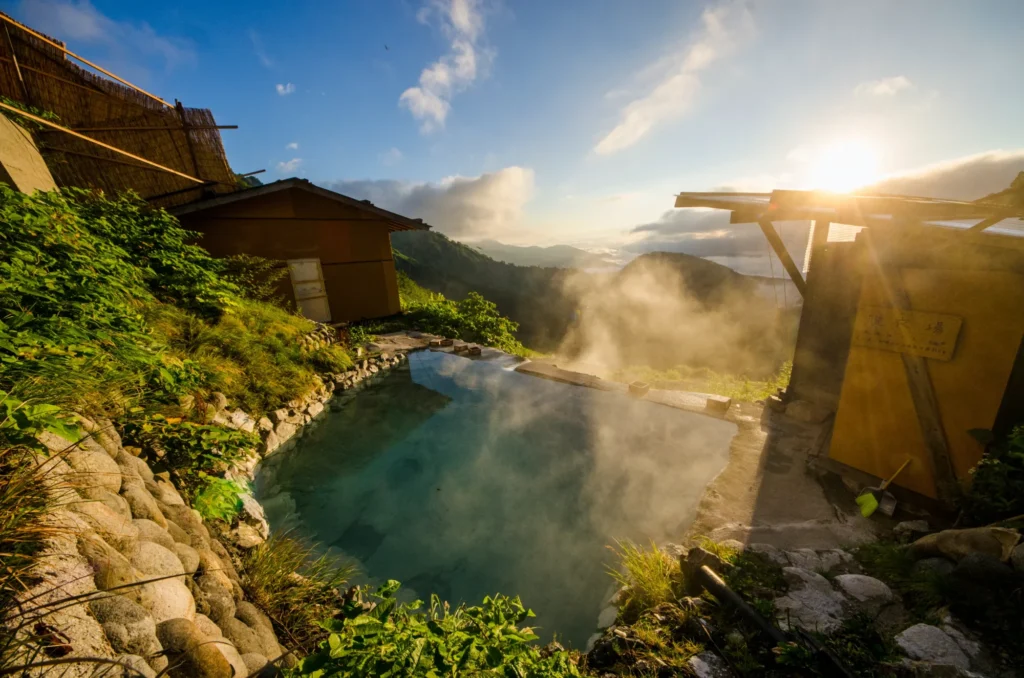
A hot spring source can emerge in several ways. Some sources appear naturally, with water rising through cracks in the earth. Others are reached by drilling underground. In some cases, the water rises on its own because of natural pressure. In others, it must be pumped up mechanically.
These differences matter because they affect how closely the bath is connected to the original source. A bath may have a source located directly on the property, or the water may be piped in from another location nearby. Both can still be high-quality onsen experiences, but they are not exactly the same.
For travelers, the key question is usually simpler: Is the water fresh, and is it being reused? That is where the meaning of gensen kake-nagashi becomes important.
Gensen Kake-Nagashi vs. Gensen 100% Kake-Nagashi
One common point of confusion is the difference between 源泉かけ流し and 源泉100%かけ流し.
A bath labeled gensen kake-nagashi uses fresh source water that is not circulated back into the tub. However, some adjustments may still be made. For example, the facility may add a small amount of water to lower the temperature, heat the water if it is too cool, or use chlorine for hygiene control.
These adjustments do not automatically mean the bath is poor quality. Many hot springs are naturally too hot, too cold, or too strong for comfortable bathing without some management. However, if water is added or heating is used, the facility should explain why.
By contrast, gensen 100% kake-nagashi usually means the water is used without dilution, heating, chlorine disinfection, or circulation. It is the closest version to bathing directly in the original source water.
There is one important detail: cooling does not always count as dilution. If the source water is too hot and the facility cools it naturally through a tank or cooling pipes, without adding water, it may still be described as 100% source-fed.
Gensen Kake-Nagashi vs. Onsen Kake-Nagashi
You may also see the phrase 温泉かけ流し, or onsen kake-nagashi. This sounds similar, but it is not always as strict.
Onsen kake-nagashi means hot spring water flows continuously into the bath and is discharged rather than reused. However, it may be more likely to involve adjustments such as added water, heating, or disinfection.
The difference is subtle but useful:
Gensen kake-nagashi emphasizes water coming from the source and not being reused.
Onsen kake-nagashi emphasizes continuous hot spring flow, but the water may be adjusted more before entering the bath.
For casual bathers, both can offer a very enjoyable onsen experience. For onsen purists, gensen kake-nagashi is usually the more desirable label.

Gensen Kake-Nagashi vs. Natural Hot Spring
Another term that often causes confusion is 天然温泉, meaning natural hot spring.
A natural hot spring is water that qualifies as hot spring water under Japanese standards. In general, this means it comes from underground and either reaches a certain temperature at the collection point or contains specific mineral components.
However, natural hot spring tells you what the water is. It does not necessarily tell you how the bath is operated.
A natural hot spring bath may still be heated, diluted, disinfected, filtered, or circulated. As long as the water itself qualifies as hot spring water, the facility may still describe it as a natural hot spring.
Gensen kake-nagashi is different. It tells you about the supply method. The bath receives fresh source water continuously, and the used water is not returned to the tub.
A simple way to remember it is this:
Natural hot spring means the water is real onsen water.
Gensen kake-nagashi means the water is fresh, source-fed, and not reused. This is the best version of it!
Is Gensen Kake-Nagashi Legally Defined?
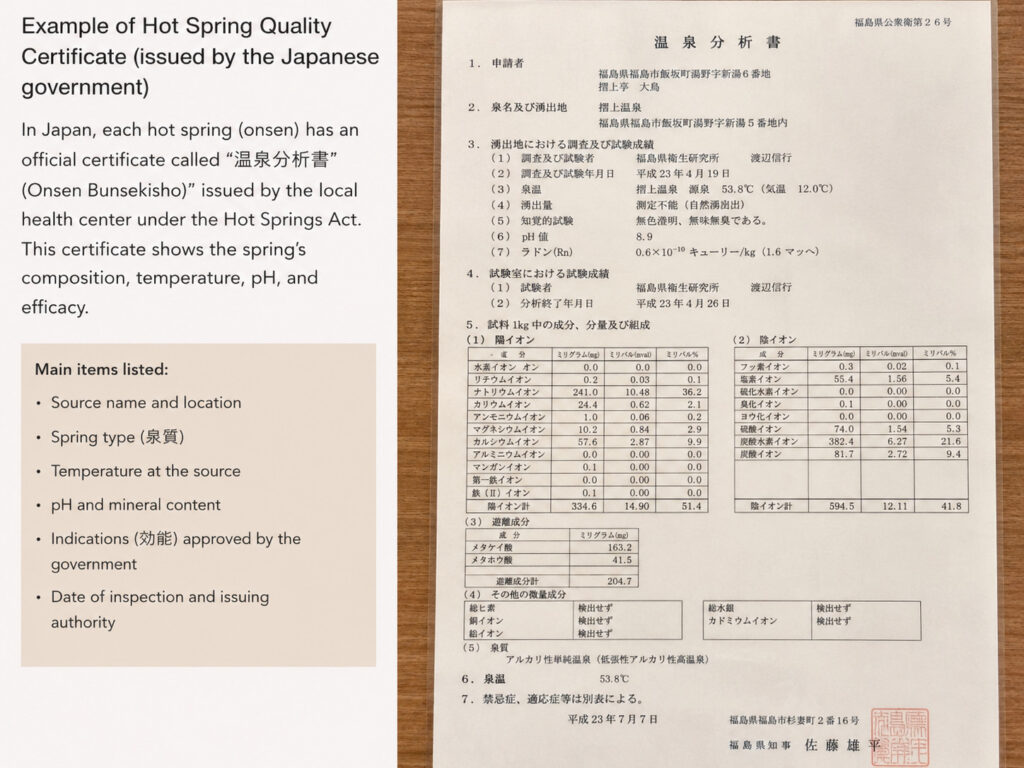
Interestingly, gensen kake-nagashi is not clearly defined in Japan’s Hot Springs Act. The law defines what qualifies as hot spring water, but it does not provide one universal legal definition for the phrase gensen kake-nagashi.
Because of this, local governments, hot spring associations, and individual onsen areas may explain the term in slightly different ways. This is one reason travelers sometimes feel unsure about what they are actually getting.
For example, a bath may be described as gensen kake-nagashi even if you do not see water dramatically overflowing from the edge of the tub. In some facilities, the water may enter from beneath the bath and drain from an outlet at the bottom. In others, the bath design makes the flow less visible.
That said, there are a few clues that may suggest a genuine source-fed bath. Mineral deposits around the tub, a noticeable natural smell, or a temperature difference between the water at the spout and the water in the bath can all indicate fresh hot spring flow.
Benefits of Gensen Kake-Nagashi Baths
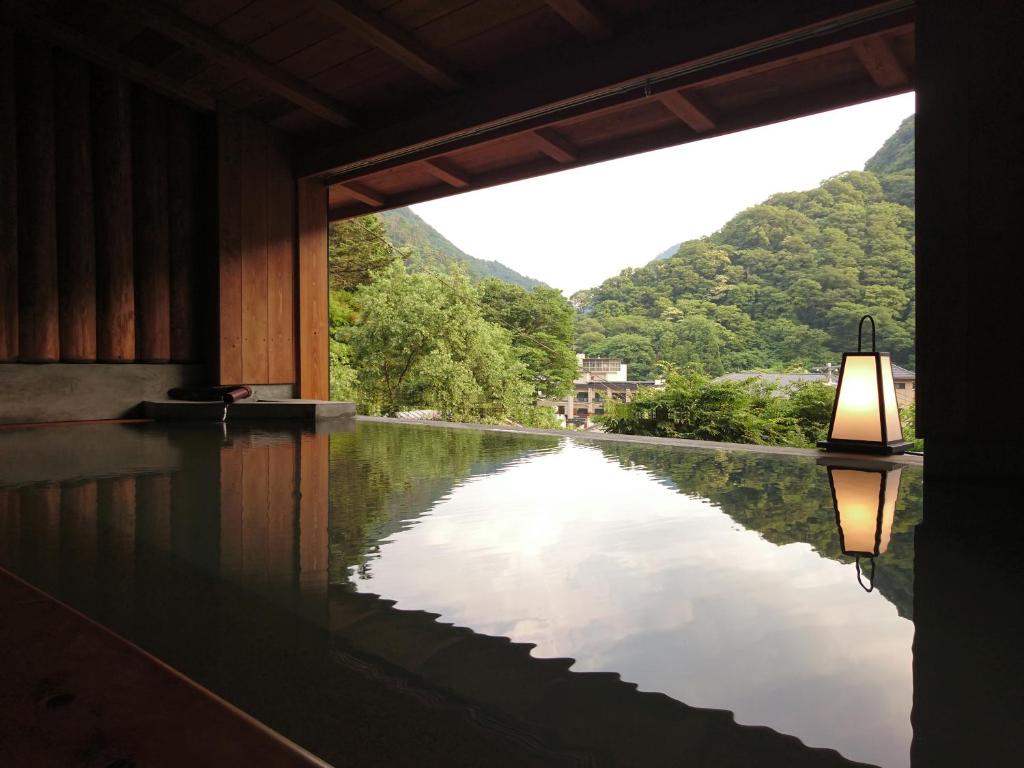
The main appeal of gensen kake-nagashi is freshness. Because new water is constantly entering the bath, you can experience the hot spring closer to its original state.
This often means the minerals, scent, color, and texture of the water feel more distinctive. Sulfur springs may smell stronger. Iron-rich springs may have a deeper color. Chloride springs may leave the skin feeling warm for longer.
Many bathers also prefer gensen kake-nagashi because the smell of chlorine is usually less noticeable than in heavily managed public baths. Even when hygiene measures are used, the continuous supply of fresh water can make the bathing experience feel more natural.
For people who travel specifically for onsen culture, this is a major part of the attraction. Gensen kake-nagashi is not just about bathing; it is about experiencing the character of the spring itself.
Drawbacks of Gensen Kake-Nagashi Baths
Although gensen kake-nagashi sounds ideal, it is not automatically better in every situation.
One challenge is temperature control. Source water may be very hot, and without much adjustment, the bath can feel uncomfortable for some people. In other cases, the water may cool too quickly depending on the season, bath size, or flow rate.
Hygiene can also depend on the amount of fresh water entering the tub. If the flow rate is too low, minerals, sediment, or dirt may build up. This is why good management is still important, even in a free-flowing bath.
Circulated baths, while less romantic to onsen enthusiasts, have practical advantages. They make it easier to maintain a stable temperature, especially in large public baths, and filtration can help remove impurities.
The best choice depends on what you value most: raw spring character, comfort, hygiene management, or consistency.
Important Onsen Terms to Know
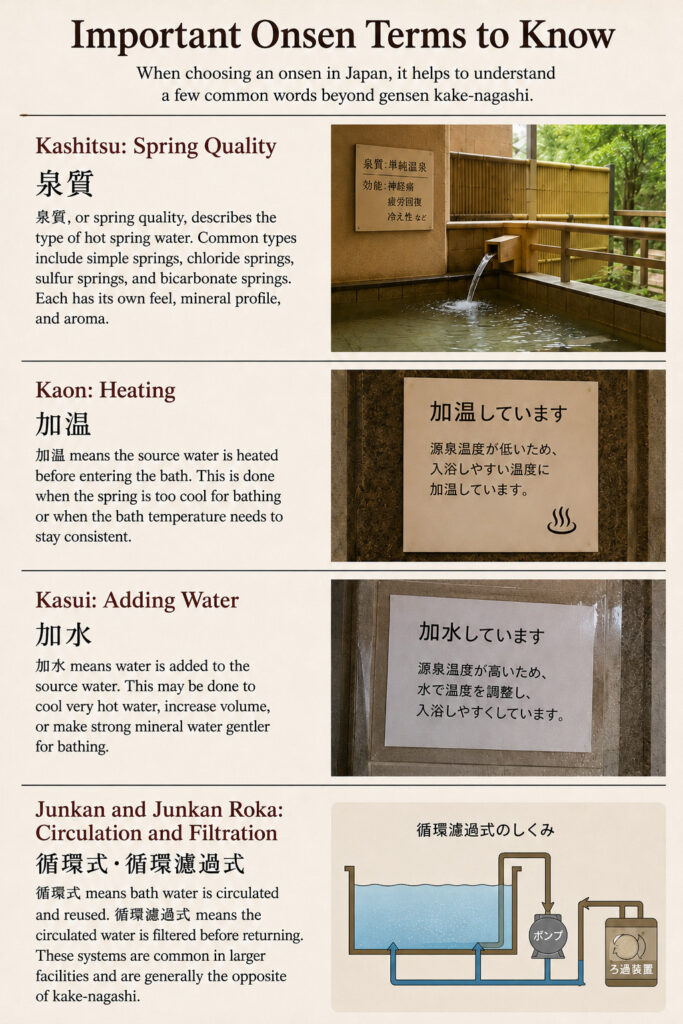
When choosing an onsen in Japan, it helps to understand a few common words beyond gensen kake-nagashi.
Kashitsu: Spring Quality
泉質, or spring quality, refers to the type of hot spring water. Japanese hot springs are classified into several main types, including simple springs, chloride springs, sulfur springs, bicarbonate springs, and others.
Each type has different characteristics. Some are known for warmth retention, some for smooth-feeling water, and others for strong mineral content or distinctive aromas.
Kaon: Heating
加温 means the source water is heated before entering the bath. This may be done with a boiler, heat exchanger, or by adding hot water.
Heating is often used when the source temperature is too low for comfortable bathing or when a facility needs to maintain a consistent bath temperature.
Kasui: Adding Water
加水 means water is added to the source water. This is often done to cool very hot spring water, increase volume, or soften water that is too mineral-rich or harsh for bathing.
Added water may come from tap water, well water, spring water, or another source. If a facility adds water, it should explain the reason.
Junkan and Junkan Roka: Circulation and Filtration
循環式 means bath water is pumped out and returned to the tub for reuse.
循環濾過式 means the circulated water is filtered before being returned.
These systems are common in larger facilities because they help manage temperature, cleanliness, and water volume. They are generally considered the opposite of kake-nagashi, although some baths may combine fresh inflow with partial circulation.
Is Gensen Kake-Nagashi Worth Looking For?
For many travelers, yes. A gensen kake-nagashi bath can offer one of the most memorable onsen experiences in Japan. The water often feels more alive, more distinctive, and more closely tied to the landscape it comes from.
However, the label should not be the only thing you consider. A well-managed natural hot spring with circulation may be more comfortable than a poorly managed free-flowing bath. Likewise, a 100% source-fed bath may be fascinating but too hot, too strong, or too rustic for every visitor.
The best approach is to look at the full picture: the spring quality, whether water is added, whether the bath is heated, whether it is circulated, and how clearly the facility explains its water management.
Final Thoughts
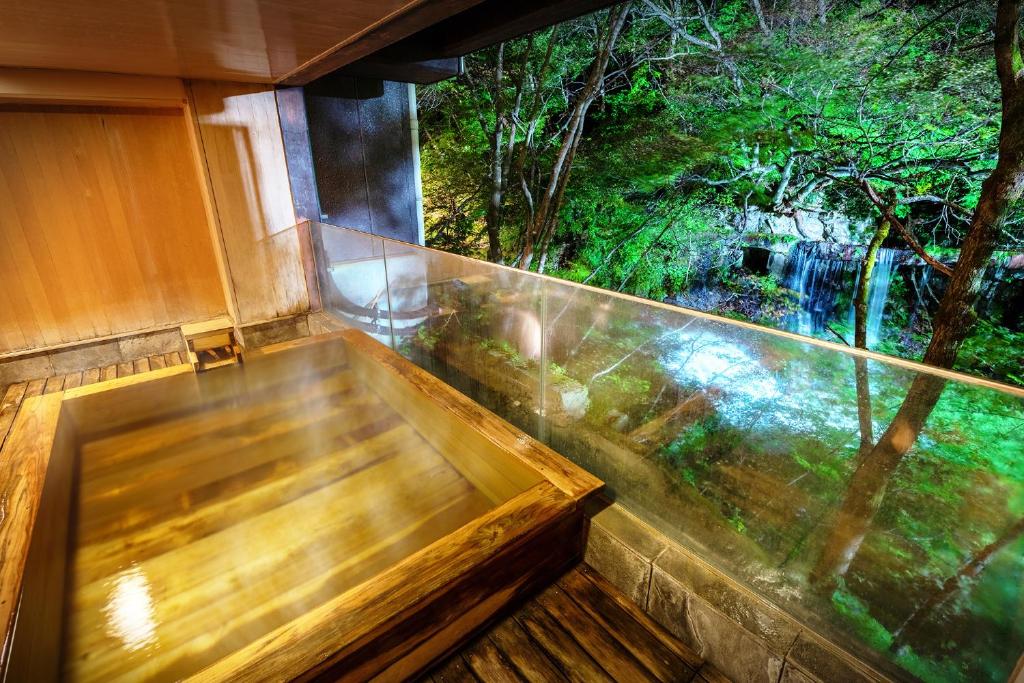
Gensen kake-nagashi means fresh hot spring water from the source flows continuously into the bath and is not reused. It is one of the most valued terms in Japanese onsen culture because it suggests a fresher, more direct bathing experience.
However, related terms can be confusing. Gensen 100% kake-nagashi usually means no dilution, heating, disinfection, or circulation. Natural hot spring means the water qualifies as real onsen water, but it may still be adjusted or reused. Onsen kake-nagashi means flowing hot spring water, though the water may be managed more flexibly.
If you want the most authentic source-fed experience, gensen kake-nagashi is a useful term to look for. Just remember that the details can vary by facility, region, and local labeling practices. When in doubt, check the posted onsen information before you bathe.
A little knowledge goes a long way. Once you understand these terms, choosing an onsen in Japan becomes easier, more enjoyable, and much more rewarding.
