
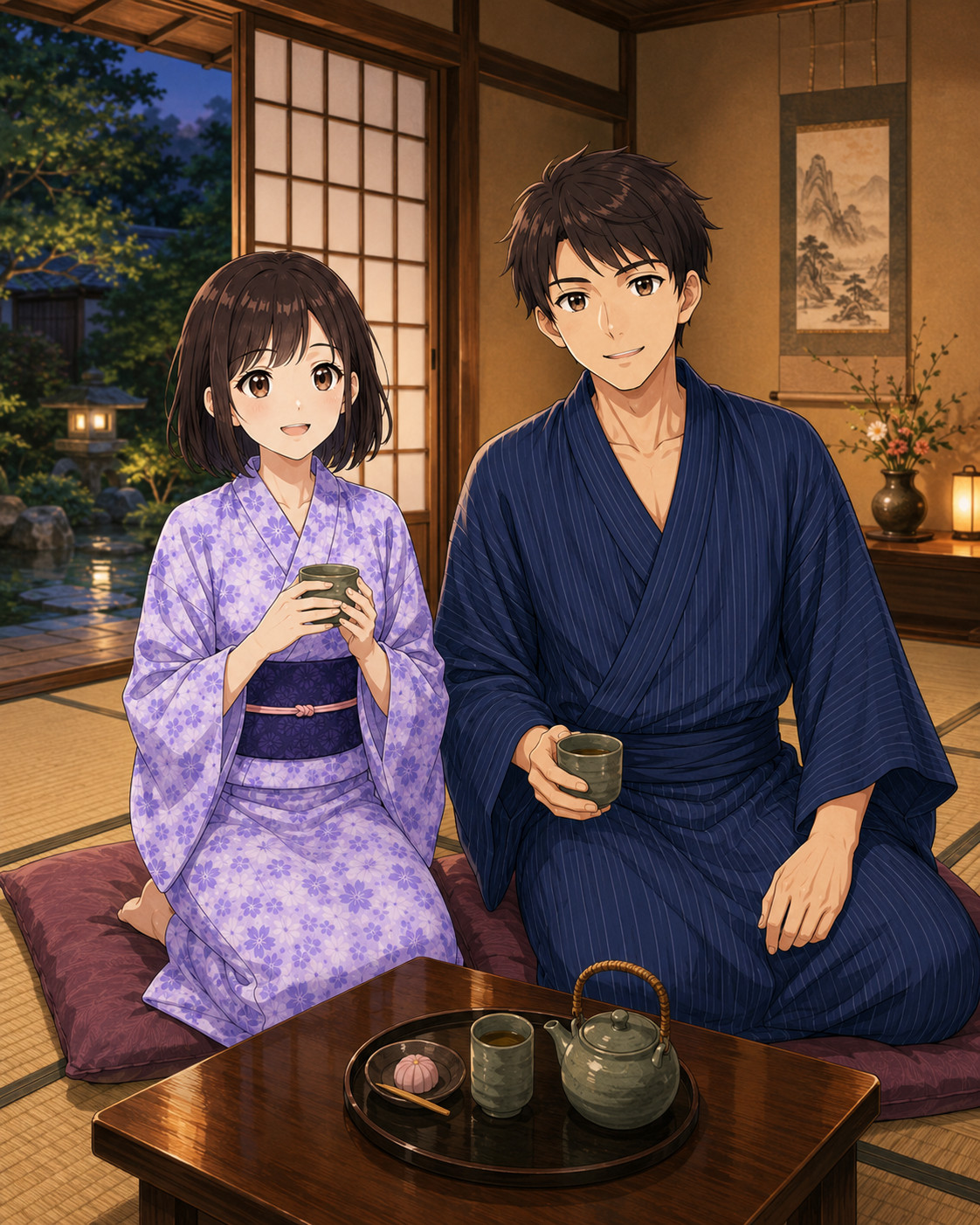
If you’re staying at a Japanese ryokan or visiting an onsen town, you’ll almost certainly be handed a yukata. These lightweight cotton robes are one of the most iconic parts of the ryokan experience but putting one on correctly for the first time can feel unexpectedly tricky.
This guide walks you through exactly how to put on a yukata, from the first fold to the final knot. By the end, you’ll look like you’ve been doing it for years.
What Is a Yukata?
A yukata (浴衣) is a casual, unlined cotton robe originally worn after bathing. Unlike a formal kimono, a yukata is lightweight and relaxed designed for warm weather, festivals, and exactly the kind of inn-life comfort you’ll find at a traditional ryokan.
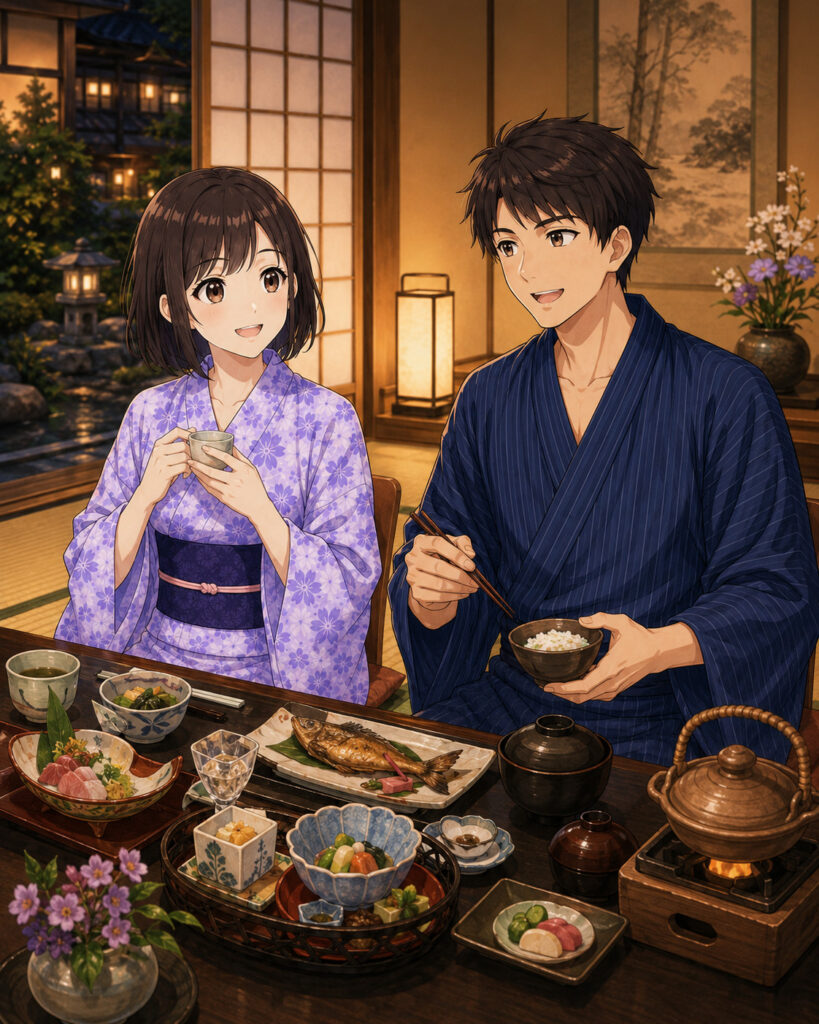
At most ryokans, a yukata is laid out in your room and is meant to be worn for everything: walking to the communal bath, eating dinner, strolling through the inn’s gardens, and sleeping. It’s completely normal — and expected — to wear it all evening.
Before you arrive at a ryokan, you will find that many establishments send you an email in advance to ask for the gender of each person and for the height. A yukata comes in different colors for men and women and it has different lenghts. Some ryokans simply put several different sizes in the room so you can pick the one that fits you best.
What You’ll Need
Most ryokans provide everything:
- Yukata — the robe itself
- Obi — the sash/belt that ties around the waist
- Tanzen — a thicker jacket worn over the yukata in cooler weather. This is only provided in the winter months.
- Tabi (足袋) – Split toed socks to fit with geta (wooden sandals) or zori (where the thong strap fits between the toes.
You’ll typically wear the yukata over nothing, or over light undergarments.
How to Put On a Yukata: Step-by-Step
Step 1: Put on the Yukata
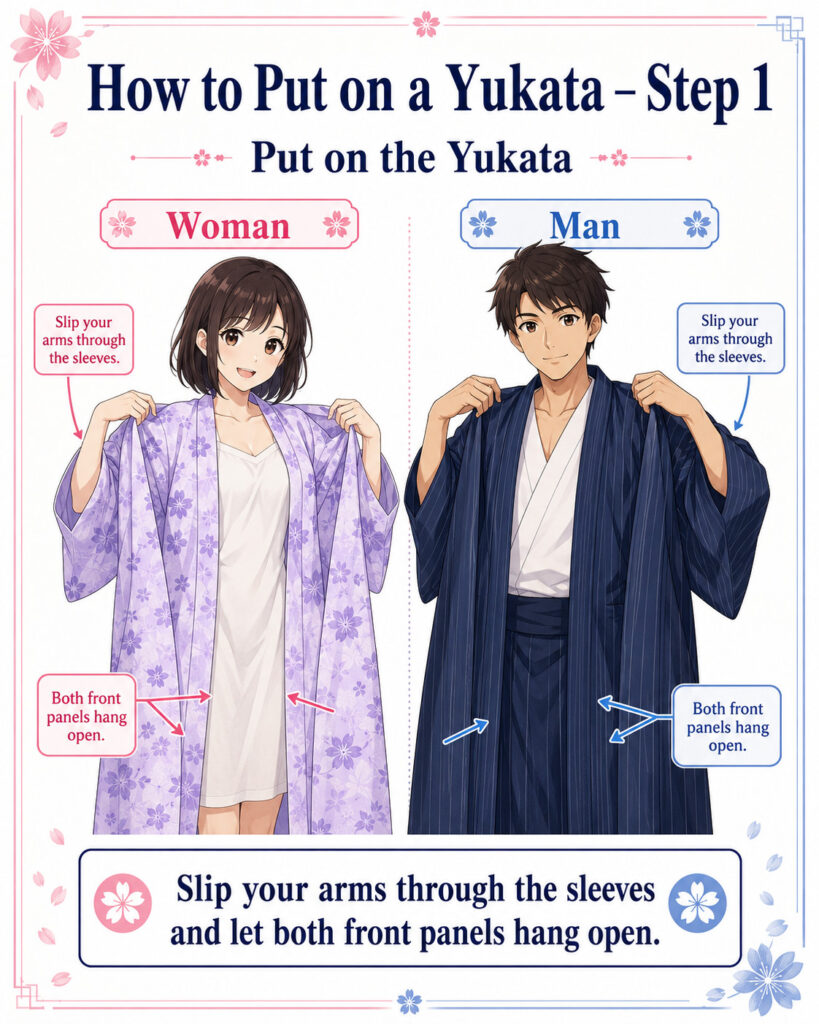
Slip your arms through the sleeves as you would with a dressing gown. The yukata should hang freely, with both panels of fabric open in front of you.
Step 2: Left Panel Over Right (!) Always (!)
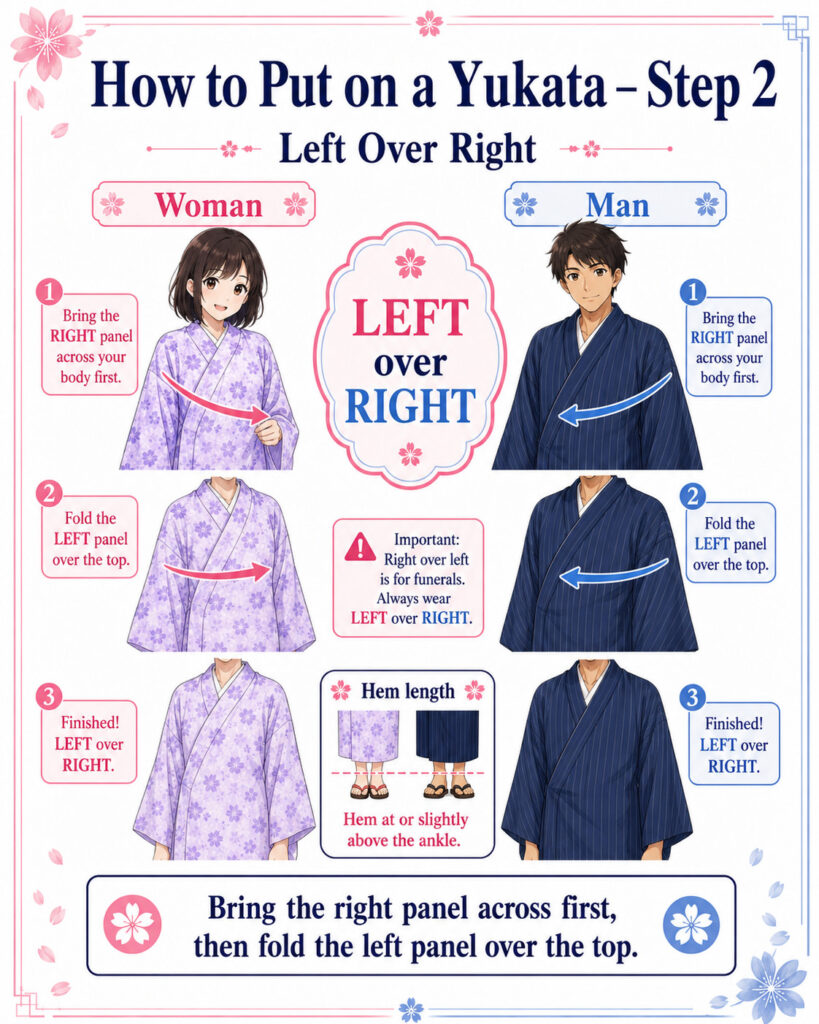
This is the most important rule: left over right.
Take the right panel and wrap it across your body first, so it sits flat against your left hip. Then take the left panel and fold it over the top, crossing it over your right side.
Important: Right over left is how a kimono is dressed for a funeral. Left over right is the correct way for the living. Don’t get these mixed up!
Make sure the bottom hem of the yukata sits just at or slightly above your ankle. If it’s too long, pull it up slightly and adjust at the waist — the obi will hold everything in place.
Step 3: Hold It in Place
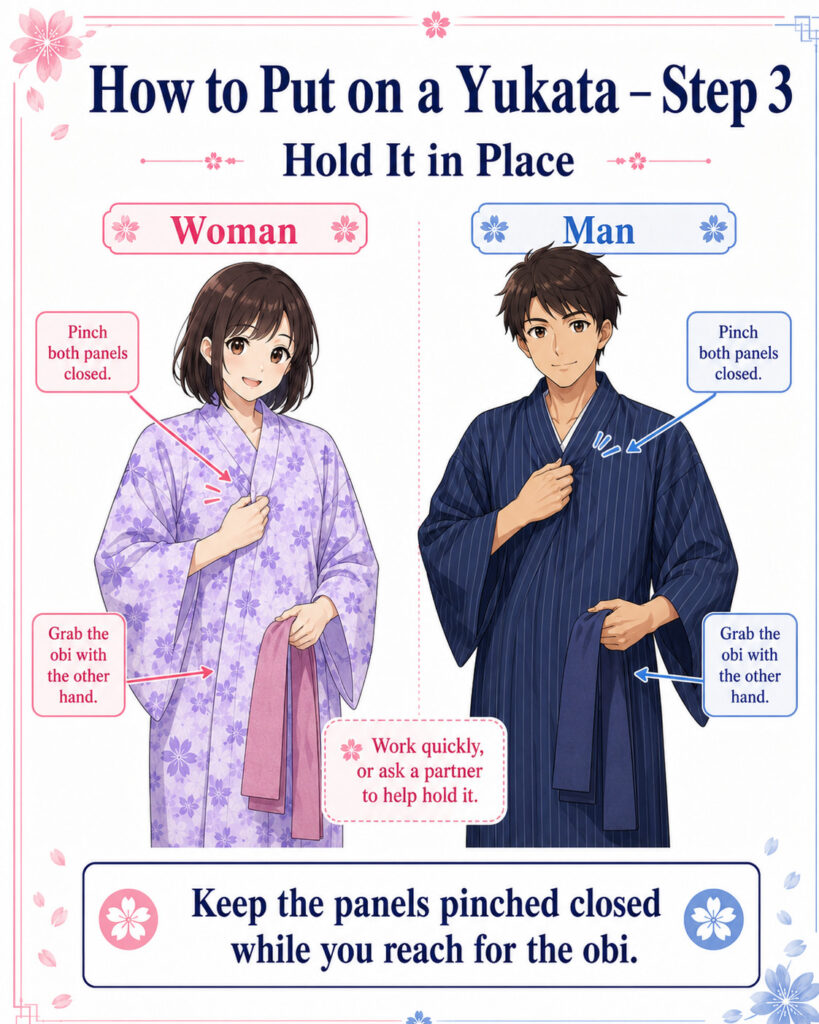
Keep both panels pinched in place with one hand while you grab the obi with the other. The yukata will slip if you let go, so work quickly here or ask a partner to hold it for you.
Step 4: Wrap the Obi
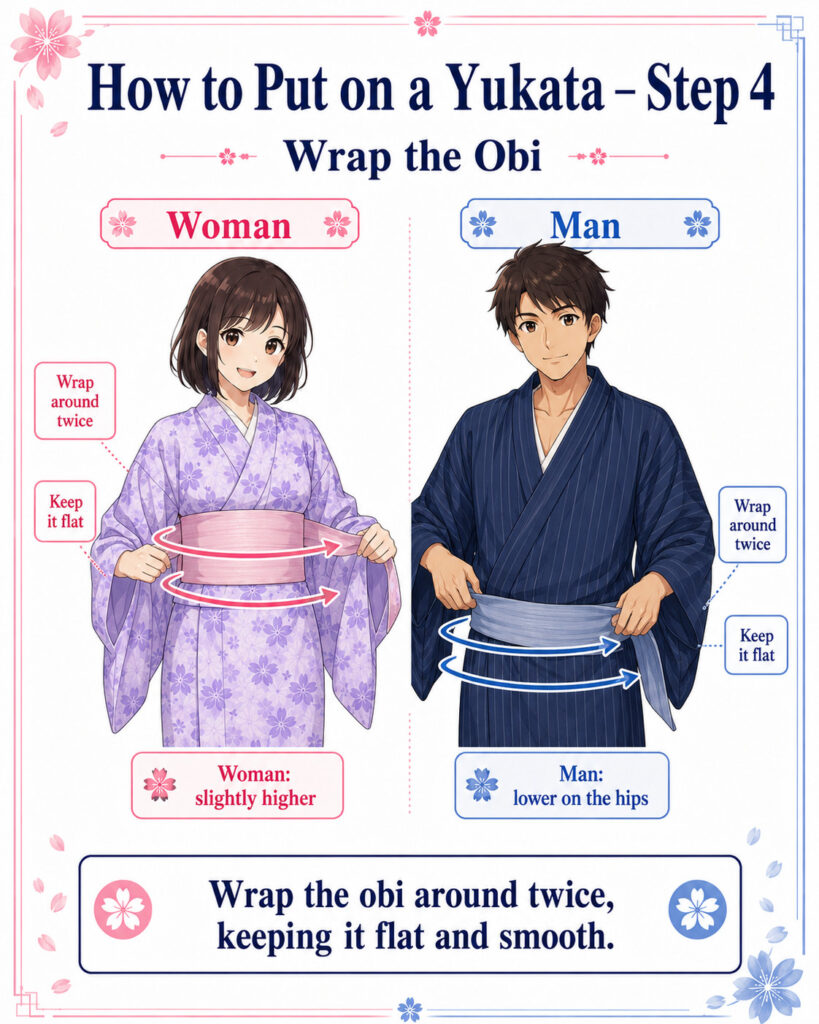
Take the obi (the long sash) and wrap it around your waist twice, starting from the front. Keep it flat — avoid bunching or twisting.
The obi should sit at or slightly below your natural waist. For women, wearing it a little higher gives a more elegant silhouette. For men, lower on the hips is traditional.
Step 5: Tie the Obi
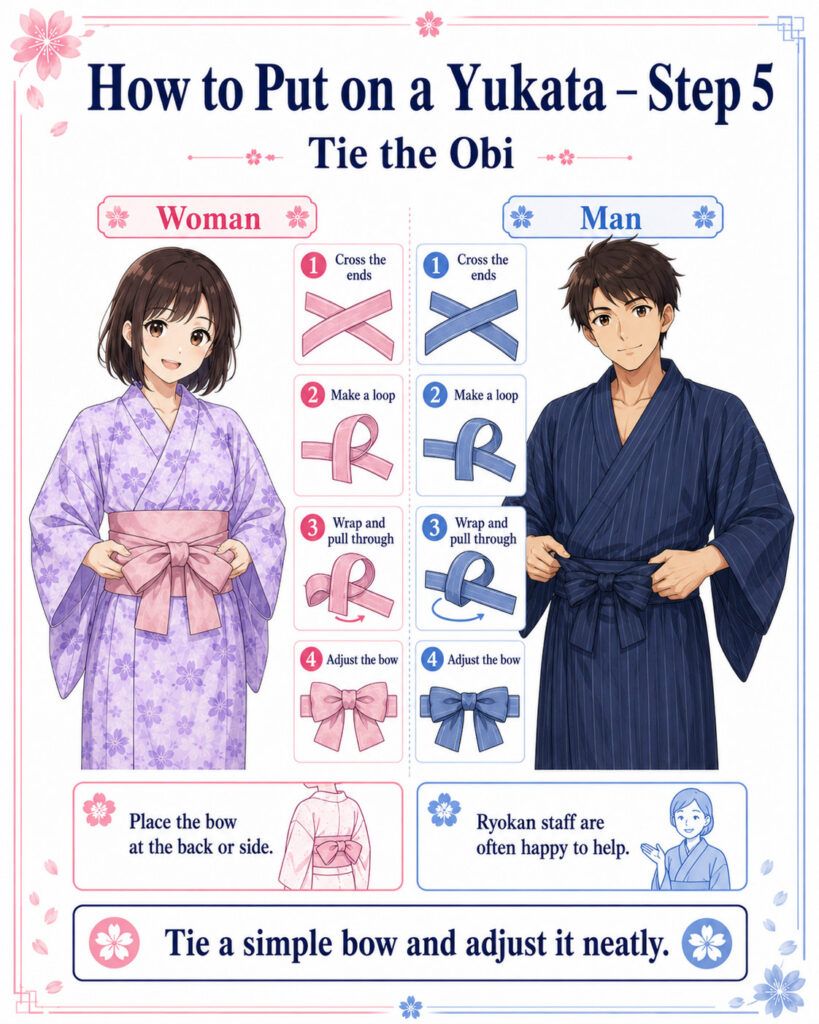
There are several ways to tie an obi, but the simplest is a basic bow knot:
- After wrapping twice, cross the two ends — right over left
- Take the top end, fold it into a loop, and bring the other end up and around it
- Pull through to form a bow
- Adjust the bow so it sits at your back or side
At most ryokans, staff are happy to help you tie your obi if you’re struggling. However, you will find that casual ryokans will offer an easy to use obi so it’s mainly used as a wrapping bow (similar to a bathing robe), rather than a sophisticated one.
Step 6: Adjust the Collar
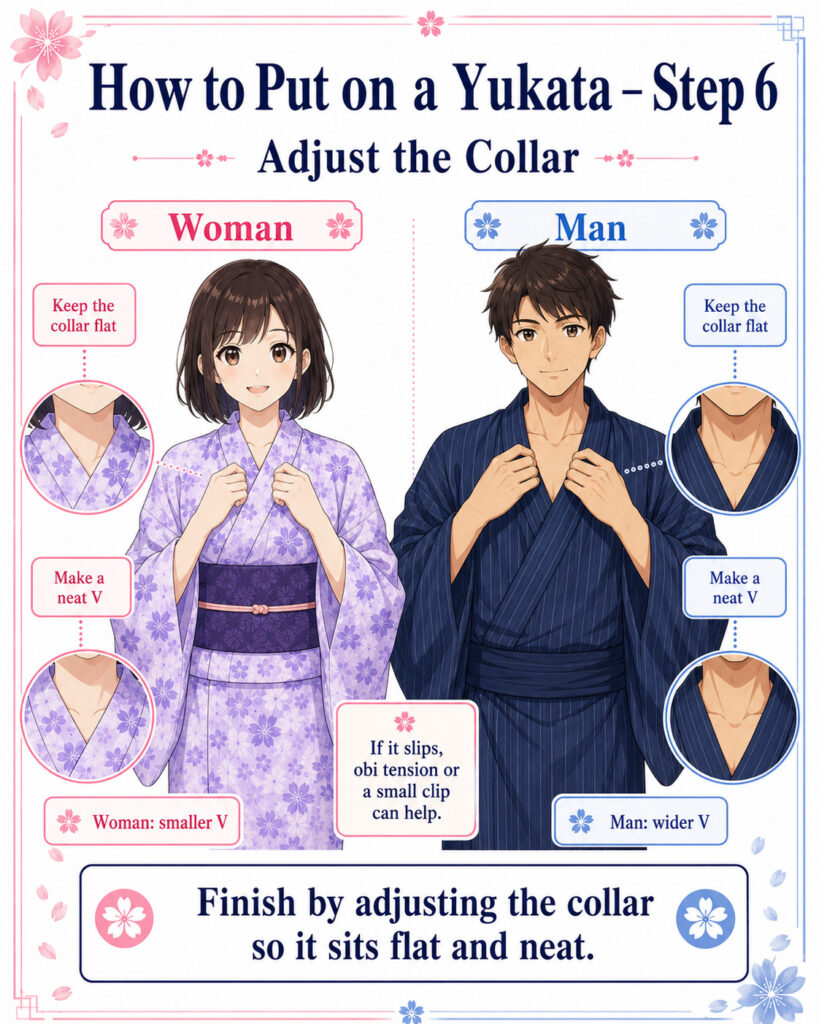
Open the collar at the front so there’s a V-shaped opening at your chest. The collar should sit flat on your chest and not bunch up. For women, a smaller V is more common; for men, a slightly wider opening is typical.
If the collar keeps slipping, a small clip or the obi tension can help hold it in place.
How to Put On a Yukata: Women vs. Men
The process is almost identical for both, with a few subtle differences:
| Yukata detail | Women | Men |
|---|---|---|
| Hem length | At the ankle | At or just above the ankle |
| Obi position | Higher on the waist | Lower on the hips |
| Obi bow | Back or side | Back or side |
| Collar opening | Smaller V | Wider V |
| Undergarments | Light shorts or a bra are fine | Usually worn directly but it’s ok to wear underwear. |
Children’s yukata follow the same left-over-right rule and are often more forgiving in terms of fit.
Common Yukata Mistakes to Avoid
1. Right over left The number one mistake. Always left over right. If you’re unsure which side is which, remember: your left hand should slip inside the folded front easily. If it can, you’ve got it right.
2. Hem too long A trailing yukata looks untidy and is a tripping hazard. Pull the excess fabric up before tying the obi. It will bunch slightly at the waist, but the obi covers this.
3. Obi tied at the front In traditional Japanese dress, an obi at the front signals a particular profession. Tie yours at the back or slightly to the side.
4. Wearing it too loose A sagging, open yukata is uncomfortable and keeps slipping. The obi should be firm but not tight.
5. Forgetting the collar It’s easy to rush the collar adjustment. Take a moment to smooth it flat before you go as it makes a big difference to how the whole thing looks.
What to Wear Under a Yukata
Most people wear a yukata directly over their skin, which is the traditional approach. However, if you’re uncomfortable with that:
- Women: a light cotton camisole or bra works fine. Avoid thick straps that show at the collar.
- Men: light boxer briefs or shorts are perfectly acceptable.
- Everyone: avoid wearing a t-shirt underneath because it bunches awkwardly and defeats the elegant drape of the yukata.
A gentle reminder that a yukata is meant to be worn en route to the onsen, so you want to remove the yukata, remove your underwear and be ready to soak.
Can You Wear a Yukata Outside?
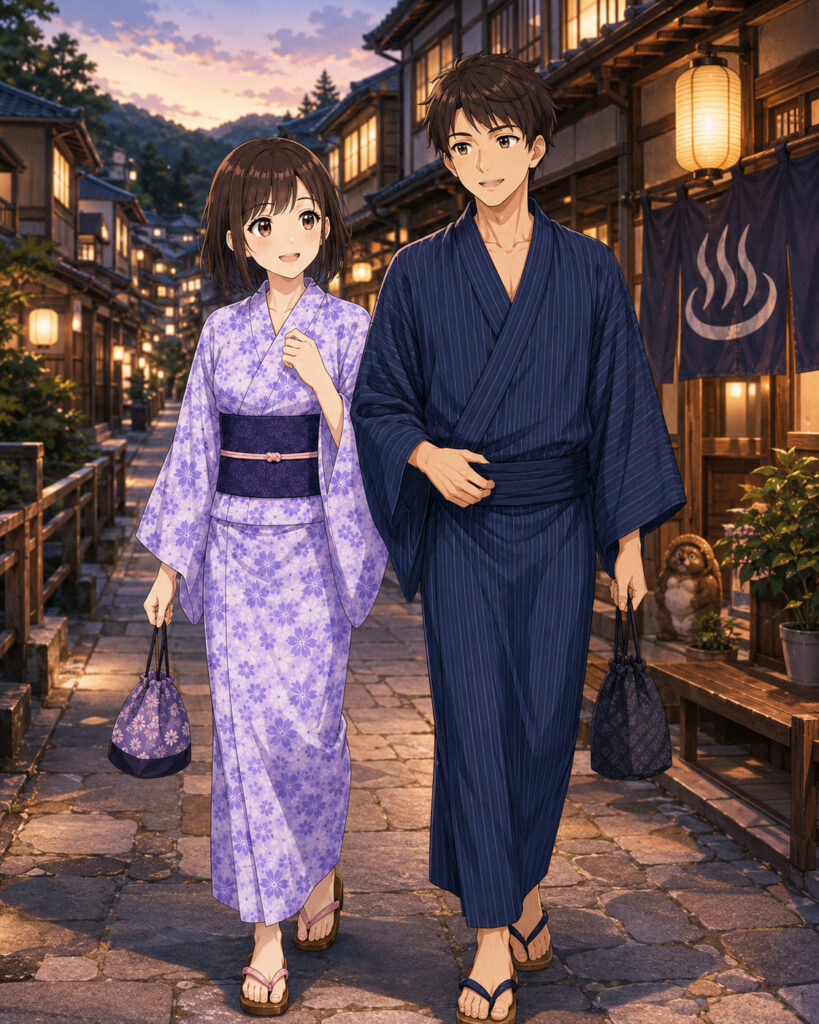
Yes, and at ryokans in onsen towns, it’s encouraged. In places like Kinosaki Onsen, Gero Onsen, and Yufuin, guests traditionally wander between public baths in their yukata and geta sandals. It’s a big part of the experience.
If your ryokan provides geta (wooden sandals), wear them with the yukata for outdoor walks. Bare feet or socks are fine indoors.
If in doubt, also don’t forget to check what is the difference between Yukata vs. Kimono.
Think of the yukata as the casual, everyday version. It’s what you’ll encounter at virtually every ryokan in Japan.
Frequently Asked Questions
Do I have to wear a yukata at a ryokan? You don’t have to, but it’s strongly encouraged and part of the experience. Most ryokans provide yukata specifically for guest use, and wearing it to dinner, the bath, and the common areas is completely normal and expected. When everyone wears it, it will be slightly unusual for you to turn up to dinner in jeans and a tshirt.
What if my yukata doesn’t fit? Most ryokans stock multiple sizes. If yours seems too short or too narrow, ask at the front desk, they’ll swap it without question.
Can I take my yukata home? No, yukata are provided for use during your stay. Some high-end ryokans sell their house yukata as souvenirs, and you can buy your own at department stores, donki (Don Quijote), and specialty shops.
Is it rude to adjust your yukata in public? Minor adjustments such as straightening the collar, re-tying the obi, are fine. A completely open yukata in a public space is not ideal, so get it right before heading out.
What’s the difference between a ryokan yukata and a festival yukata? Ryokan yukata tend to be plain or subtly patterned (often with the inn’s logo or a traditional motif). Festival yukata worn at summer matsuri are more decorative and colourful, often with bold floral or geometric patterns.
Experience a Yukata the Right Way: Stay at a Ryokan
The best way to learn how to wear a yukata is simply to stay at a ryokan. You’ll have staff on hand to help, plenty of time to practice, and the full context of the onsen experience to enjoy it in.
Japanese Onsen lists hundreds of ryokans across Japan — from budget-friendly options to luxury hideaways — so you can find the perfect place to try it for yourself.
