
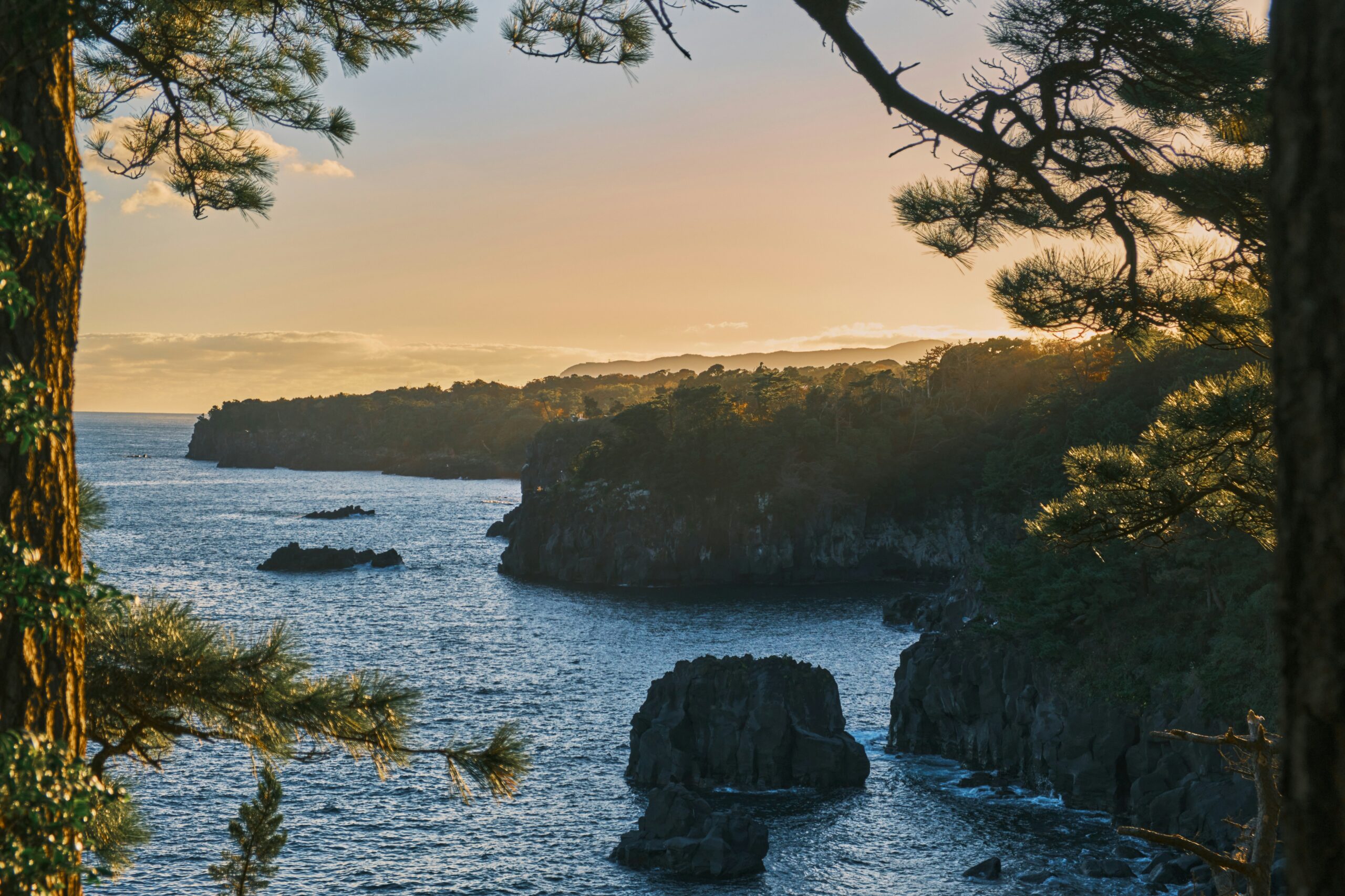
Ito Onsen is one of the easiest great onsen towns to reach from Tokyo, and one of the most underrated. Tucked into the eastern coast of the Izu Peninsula in Shizuoka, Ito produces more hot spring water than almost anywhere else in Japan, ranking third nationwide in total output. Yet most international travellers speed past it.
In one compact seaside town you get steaming public baths from ¥250, a preserved 1928 wooden bathhouse, a dormant volcano you ride a chairlift up, dramatic coastal cliffs, and a direct historical link to the real samurai-era story behind Shōgun. This guide covers exactly how to get to Ito Onsen, what to do when you arrive, and where to stay.
How to Get to Ito Onsen from Tokyo
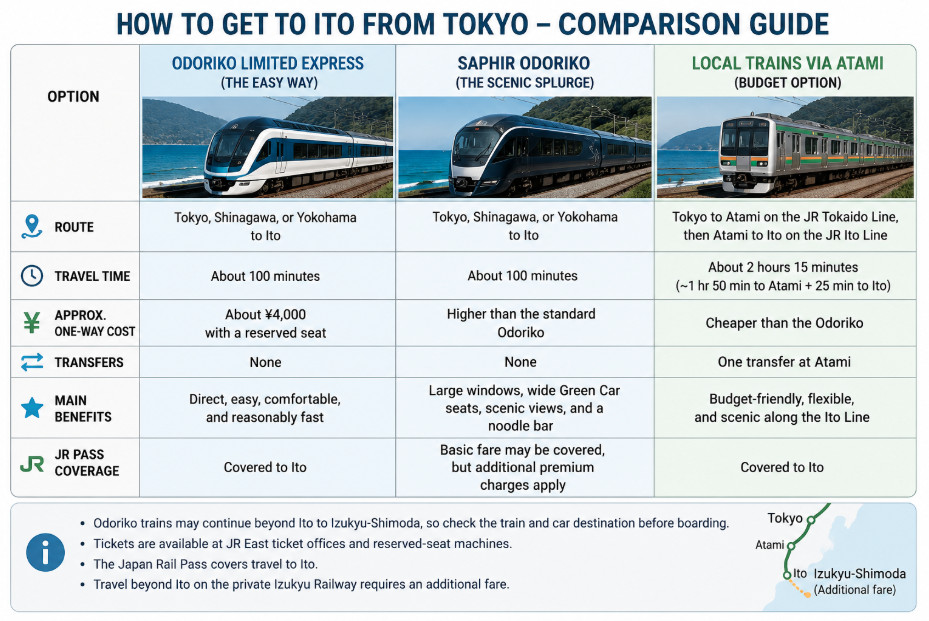
Ito is a genuine 100-minute escape from Tokyo and there are no transfers required if you take the right train.
Odoriko Limited Express (the easy way)
The JR Odoriko runs direct from Tokyo Station (also stopping at Shinagawa and Yokohama) to Ito Station in about 100 minutes, for roughly ¥4,000 one way with a reserved seat. Trains continue down the coast to Izukyu-Shimoda, so double-check you board a car bound for Ito/Shimoda. Buy tickets at JR East ticket offices or reserved-seat machines at Tokyo, Ueno, or Shinjuku.
Saphir Odoriko (the scenic splurge)
The all-Green-Car Saphir Odoriko covers the same route in the same ~100 minutes but with huge windows, wide seats, and a noodle bar — worth it if the journey is part of the treat. Expect to pay noticeably more than the standard Odoriko; premium cars sell out early on weekends.
Budget option: local trains via Atami
Take the JR Tokaido Line from Tokyo to Atami (~1 hr 50 min by local/rapid train), then transfer to the JR Ito Line for the 25-minute coastal hop to Ito. Slower, but cheaper and flexible, and the Ito Line hugs the sea.
Is the JR Pass valid?
Yes, the Japan Rail Pass covers the Odoriko as far as Ito (the line beyond Ito to Shimoda is the private Izukyu Railway and needs a supplement). If you’re on a JR Pass, Ito is effectively a free side trip.
The Best Things to Do in Ito
The things to do in Ito split neatly into two zones: the walkable onsen town around the station and Matsukawa River, and the volcanic coastline 20–30 minutes south by bus.
Soak in the town’s public baths
Ito’s identity is its onsen water. The town runs a network of around ten community public baths where a soak costs about ¥250, a fraction of resort onsen prices and about as local an experience as Japan offers. Expect simple facilities, hot water (Ito’s springs are among the hottest in Shizuoka), and neighbourhood regulars. Bring your own towel or buy one at the door.
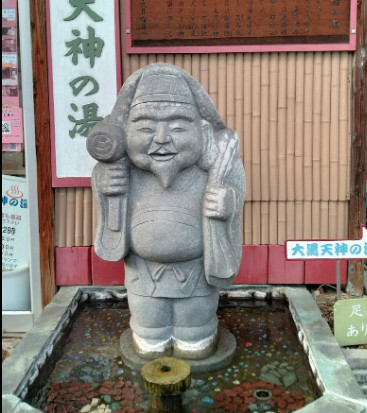
The easiest to try is Yukawa Benten-no-yu, hidden down an unmarked alley in a residential block just a 4–5 minute walk from Ito Station (¥350, 2pm–10pm, closed Wednesdays). It’s everything a resort onsen isn’t: a small Benten statue by the door, a retro tiled tub in the centre of the room, and colourless, slightly alkaline water flowing straight from the source at around 42°C with no reheating and no additives. There are no showers or shampoo, so bring a towel and soap, and expect to share the tub with locals rather than tourists. Two hundred metres away sits Matsubara Daikokutenjin-no-yu if one bath turns into two.
Tokaikan — the 1928 bathhouse landmark
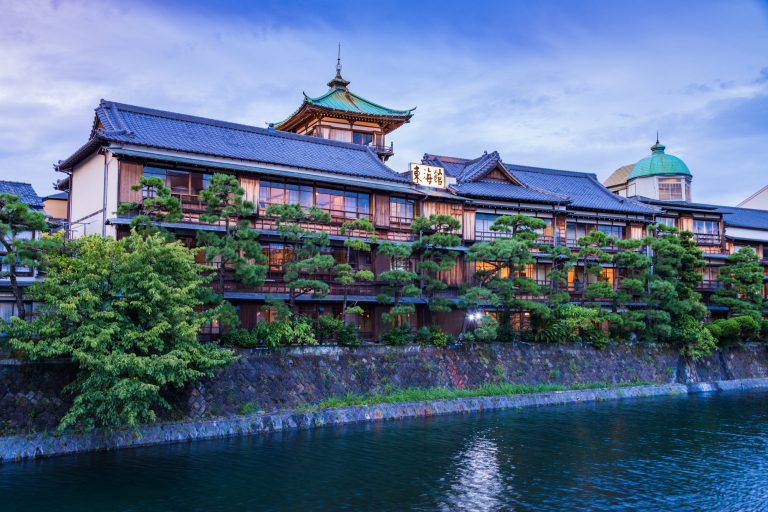
The Tokaikan is Ito’s postcard image: a three-storey wooden former ryokan on the Matsukawa River, built in 1928 and now open as a museum (¥200, 9am–9pm). Wander the corridors and craftsman-built guest rooms freely, then (the bit most visitors miss) pay an extra ¥500 to bathe in its retro tiled bath (11am–7pm, days vary). Few places in Japan let you soak inside an architectural monument.
Mount Omuro
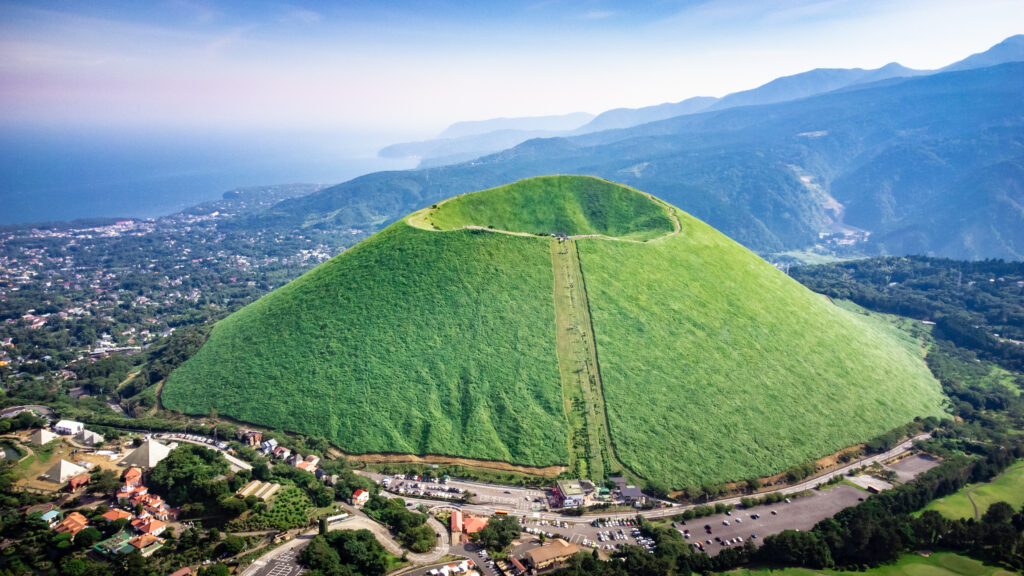
Twenty minutes south of the station sits Mount Omuro, a perfectly bowl-shaped dormant volcano. A chairlift carries you to the 580 m summit rim, which you can walk around in about 30 minutes with views across the Izu Peninsula, the Pacific, an, on clear days, Mt Fuji. Note: hiking up on foot is not allowed; the chairlift is the only way up.
Visting Mount Omuro is safe since it’s a dormant cinder cone which erupted once, about 4,000 years ago, and hasn’t since. The perfect bowl shape you ride the chairlift up is the result of that single eruption.
Jogasaki Coast
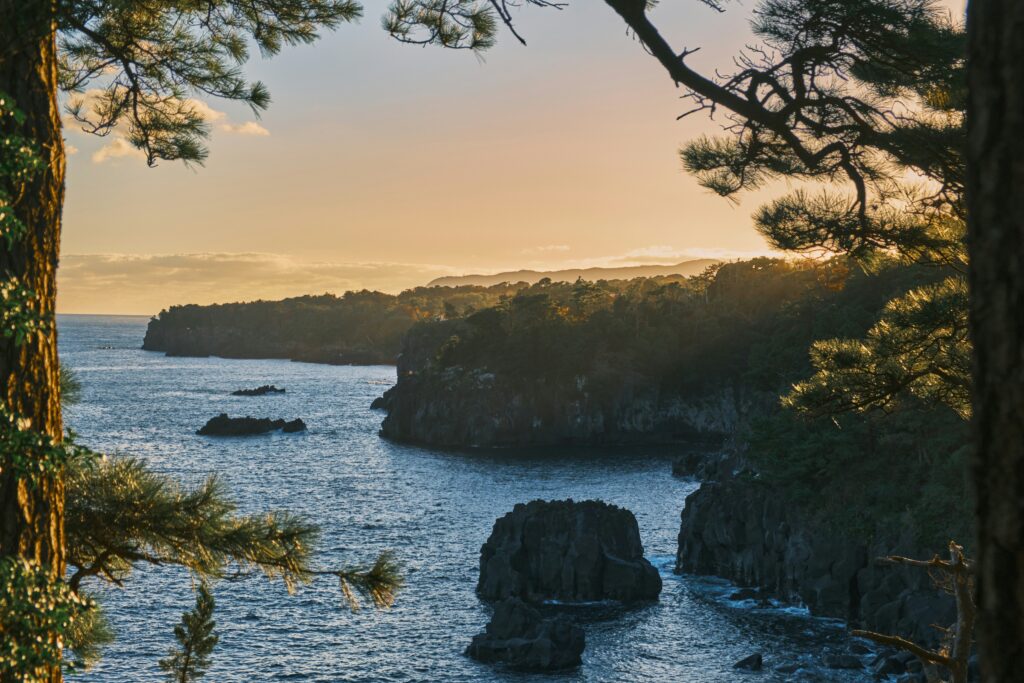
The Jogasaki Coast is where Omuro’s ancient lava met the sea: 9 km of jagged cliffs, pine forest, and cobalt water. The highlight is the Kadowaki suspension bridge slung between clifftops, plus a lighthouse lookout. Do the short bridge loop in under an hour, or hike a longer stretch of the coastal trail. Combine Omuro and Jogasaki into one half-day since they’re neighbours.
Stroll the Matsukawa River promenade
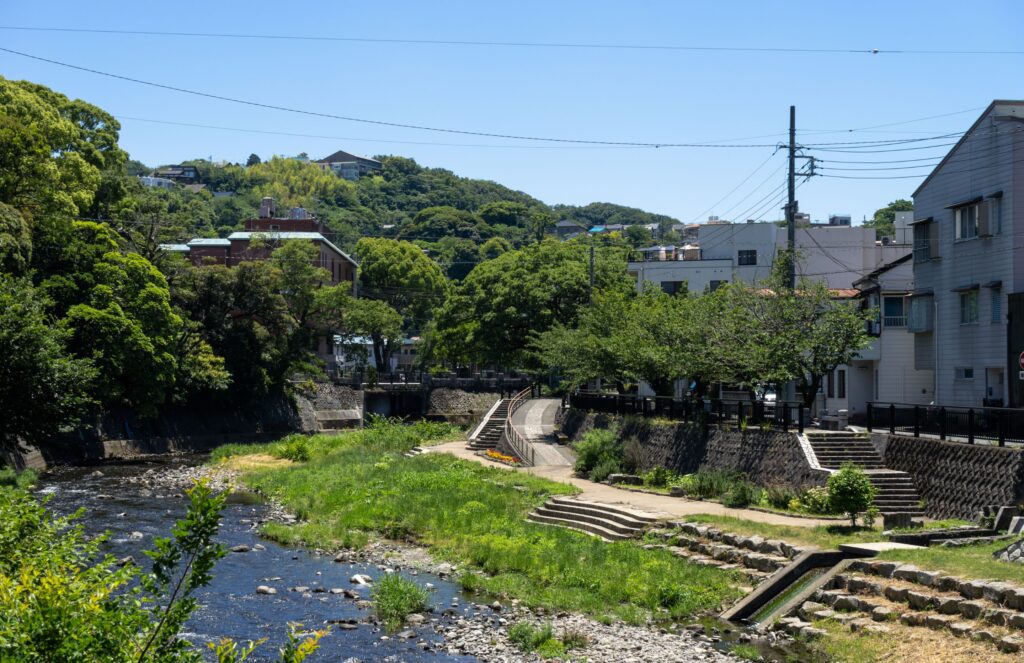
Back in town, the willow-lined Matsukawa promenade links the station area, Tokaikan, and the harbour. Ito was a favourite of writers, including the Nobel laureate Yasunari Kawabata who stayed in town while working on The Dancer of Izu. Plus you will love it since the riverside retains that early-Showa resort feel.
The William Adams (Shōgun) connection

If you watched Shōgun, you already know Ito’s most famous resident. English navigator William Adams — Miura Anjin, the real-life basis for John Blackthorne — built Japan’s first Western-style ocean-going ships right here at the mouth of the Matsukawa River, on the orders of Tokugawa Ieyasu. Ito honours him every August with the three-day Anjin Festival: taiko drumming, floating lanterns, and a finale of around 10,000 fireworks over the bay which is one of Izu’s biggest summer events. However, 2026 is a special year as the festival celebrates its 80th anniversary, thus welcoming twice the usual amount of fireworks, plus tickets for special viewing seats. There are more annual events so make sure to check the calendar.
For families: Izu Granpal Park
Izu Granpal Park offers zip lines, go-karts and rides by day, and the Granillumi illumination event on seasonal evenings.
Day Trip or Overnight?
You can do Ito as a day trip from Tokyo. Being just 100 minutes each way makes it one of the closest real onsen towns to the capital. But Ito rewards a night: the public baths are best in the evening, ryokan dinners showcase Izu seafood, and Mount Omuro plus Jogasaki deserve an unhurried half-day. Verdict: day-trip the town sights if you’re short on time; stay one night if you want the actual onsen-town experience. I will always recommend staying at least one night in Ito.
Where to Stay in Ito Onsen
Ito Ryokuyu
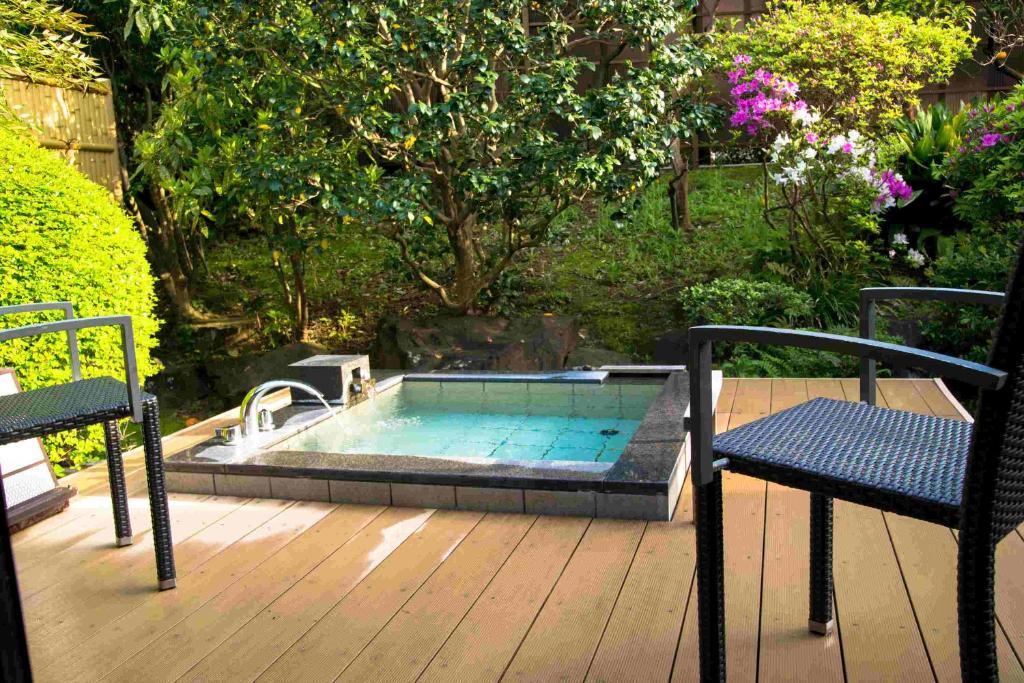
Ito Ryokuyu is the most intimate stay in town — just seven rooms, each with its own private garden open-air bath fed straight from the ryokan’s own spring source. The atmosphere is deliberately Showa-retro, dinner and breakfast are served in your room (the kinmedai — golden eye snapper — is the house speciality), and there’s even a drinking-spring station, a rarity in Ito. If your ideal onsen trip involves never sharing a bath and barely leaving your room, this is it. [View listings →]
Seizan Yamato
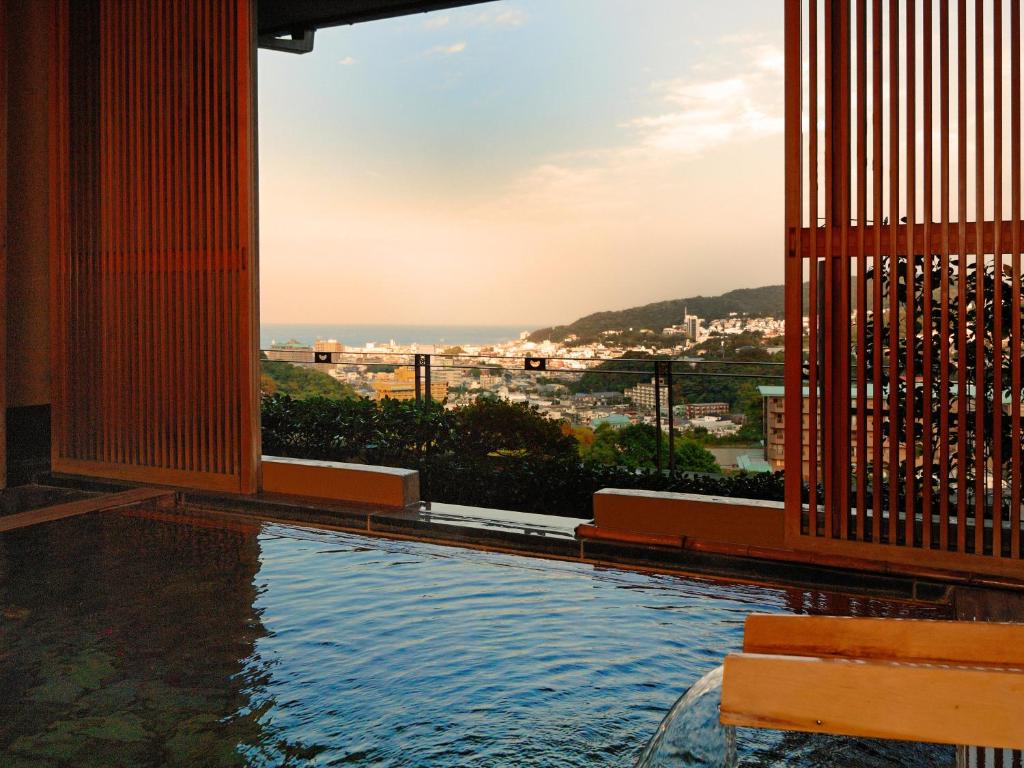
Seizan Yamato is the classic hilltop ryokan of Ito: 42 rooms above the town with views down over the rooftops to Sagami Bay. Three blended spring sources feed the 24-hour baths, several rooms have their own open-air tubs, and rentable private baths cover everyone else. In-room kaiseki dinners and a proper concierge make it the safe, polished choice for a first ryokan stay without Tokyo-luxury prices. [View listings →]
Ito Hotel Juraku
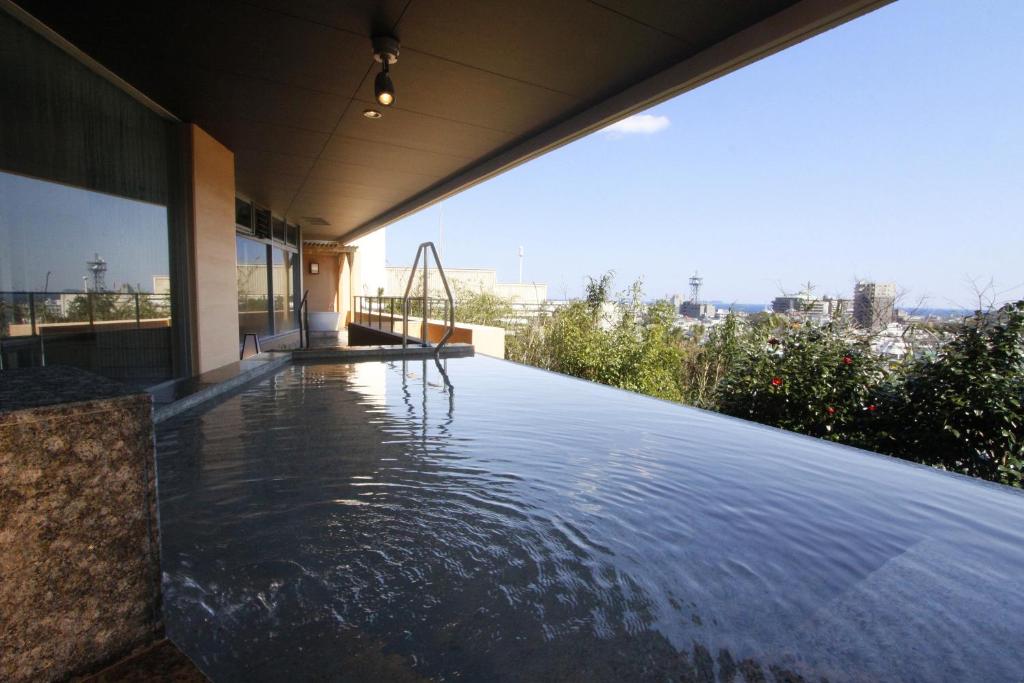
Ito Hotel Juraku is the big-view option — a ten-storey resort hotel where every room faces the ocean and the balconies come with their own foot baths. The open-air gensen baths pour Ito’s weakly alkaline, skin-softening water with the sea filling the horizon, and premium rooms on the top floors add private outdoor tubs. Choose it over a small ryokan if you want space (rooms run 39–88 m²), facilities, and that first-morning view. [View listings →]
Bogaian
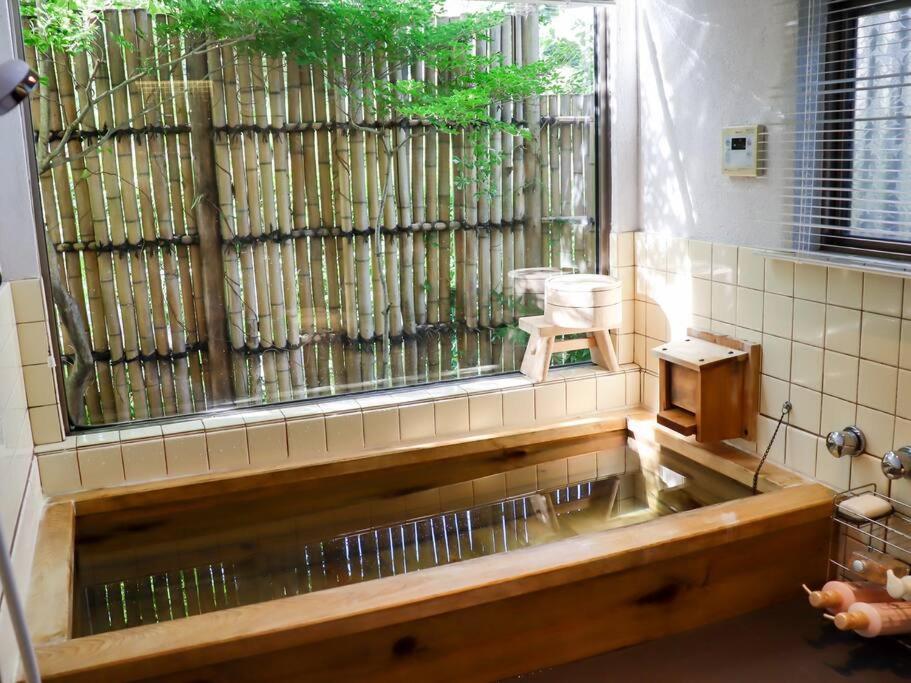
Bogaian flips the ryokan formula: instead of a room in an inn, you rent the entire house. Perched on a hillside in Izu Kogen with an ocean-view terrace, it pairs tatami rooms and loft bedrooms with a natural hot spring hinoki bath that’s yours around the clock — no bathing hours, no strangers, and tattoos are no issue. With a kitchen on hand and breakfast provided, it’s the pick for families or groups of friends who want onsen life on their own schedule. [View listings →]
Izu Coco Glamping Resort
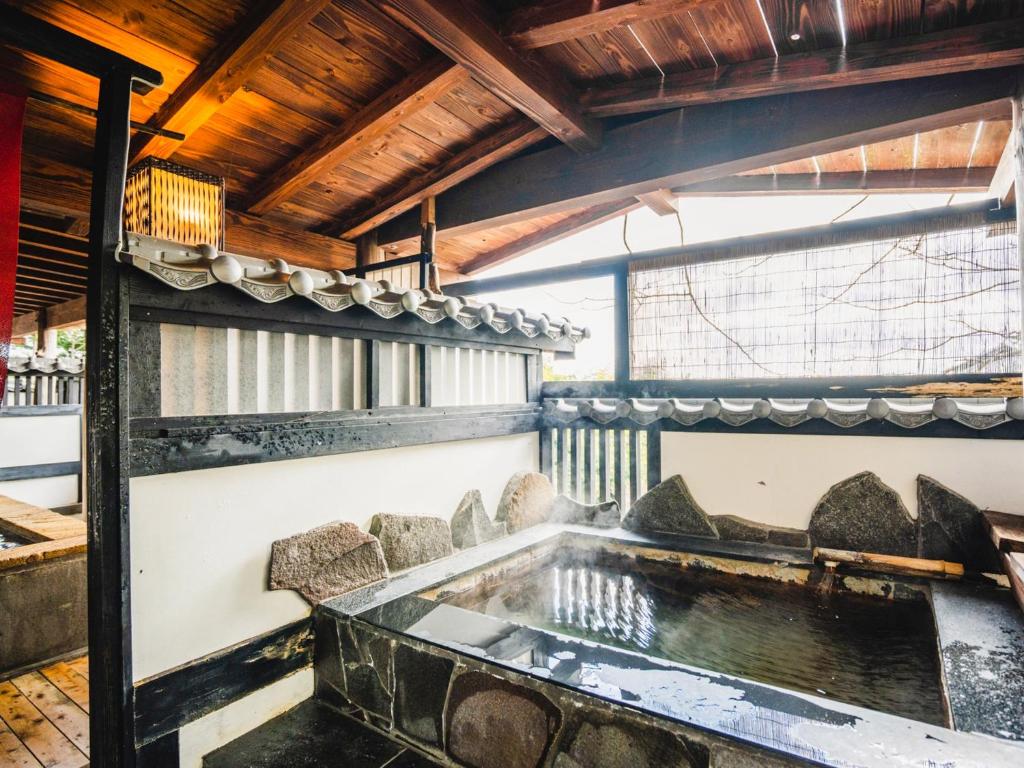
Izu Coco Glamping Resort is for travellers who want the onsen without the tatami. Six hotel-grade dome and bell tents sit on a hilltop above Sagami Bay, each with air conditioning, a private shower and toilet, and a wood deck for BBQ dinners under the stars — plus a private natural hot spring bath included at no extra charge. It’s the most unconventional way to soak in Ito, and the one kids will talk about afterwards. [View listings →]
Best Time to Visit Ito
Ito works year-round: late June–early July for Jogasaki’s hydrangeas and fewer crowds, August for the Anjin Festival fireworks, autumn for clear Fuji views from Omuro, and winter, when steaming outdoor baths feel best and the town is quietest. Cherry blossom season along the Matsukawa is short but lovely. Avoid summer weekends if you dislike crowds because Ito is a classic Tokyo getaway.
Ito Onsen FAQ
Is Ito Onsen worth visiting? Yes — especially if you want an authentic, affordable onsen town within two hours of Tokyo. Ito ranks third in Japan for hot spring output, has ¥250 public baths, and pairs bathing with real sights like Mount Omuro and the Jogasaki Coast.
How do I get to Ito from Tokyo? Take the direct JR Odoriko limited express from Tokyo Station — about 100 minutes and roughly ¥4,000. Budget travellers can ride the Tokaido Line to Atami and transfer to the JR Ito Line. The JR Pass is valid as far as Ito.
Ito or Atami — which is better? Atami is closer (under an hour by shinkansen) and more built-up; Ito is smaller, cheaper, and feels more like a traditional onsen town, with better access to Mount Omuro and Jogasaki. For a resort-hotel weekend, pick Atami; for onsen-town atmosphere, pick Ito.
Can you visit Ito as a day trip from Tokyo? Yes. At 100 minutes each way it’s very doable, but the baths, ryokan dinners, and coastal sights are far better with an overnight stay.
What is Ito famous for? Its exceptional volume of hot spring water, the 1928 Tokaikan bathhouse, Mount Omuro’s chairlift-topped crater, the Jogasaki Coast, and its history as the place William Adams (Miura Anjin, the real Shōgun Englishman) built Japan’s first Western-style ships.
Are Ito’s onsen tattoo-friendly? Policies vary by facility. Small public baths are often more relaxed than resort hotels, and several ryokan offer private rentable baths (kashikiri) that sidestep the issue. Bogaian for example, is tattoo friendly.
Ito is the perfect first stop on an Izu Peninsula loop but as always, I recommend adding Atami, Shuzenji and Shimoda for a more complete trip.
